


Book Description:
The book, entitled “Mossy Rocks, of The Overlasting Echo” and published by Elexmedia Komputindo, Kompas Gramedia, tells the story of three historical sites in Lebak, Banten, whose existence is deemed as sacred by the Kasepuhan (a traditional community in the Sunda tribe).
The three historical sites are as follows: first, the Kosala Site, which is famous for the story of Prabu Kian Santang and its purification pool; second, the Cibedug Site, synonymous with its magnificent terraced altars and diverse artifacts; and third, the Parigi Site, that is iconic for its usage of stones as practical tools.
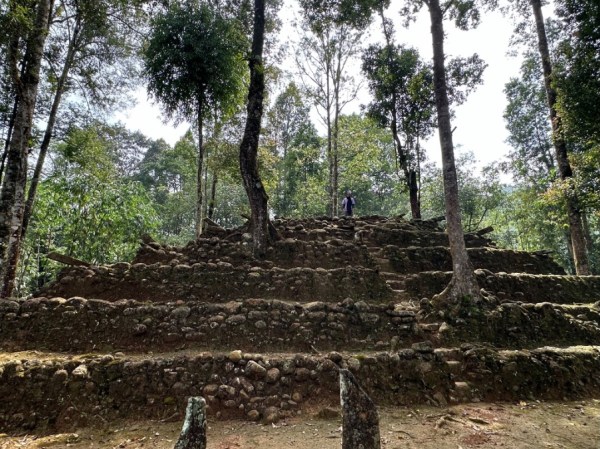
These three historical sites left behind tangible and intangible items. The tangible items are the physical remains, such as the punden berundak (earth-and-stone steps with pyramid-like structure), menhirs, and dolmens. Meanwhile, the intangible items are the spiritual connection between the community and the sites. This also includes how they immortalized the stories of their ancestors in it.
They perform ritual ceremonies, believe in myths, and avoid taboos—practices that are often regarded as unusual through the modern lens. Although in actuality, these activities are one of many ways for humans to maintain their relationship with nature.
These myths are not just meant to scare people; they can also be seen as a mechanism for Mother Nature to protect herself from human greed. These rituals are also done to honor Mother Nature, who has provided sustenance to every living being.
They believe and adhere to these rituals, believing it is their duty to pay respect to the sacred site. To the Giver of Life.
Mossy Rocks, of The Overlasting Echo
“Mulangkeun anu ka pungkur, ngarepi ka hareupeun,” which means, “I am grateful for this year’s and last year’s harvest, I wish for smooth sailing in the future”.
Quoted Udin in an interview. His eyes were sparkling, and his hands were moving enthusiastically as he answered every question. As if he was trying to “sell” the greatness of the Cibedug Site. He said that the Cibedug Historical Site is vital for the Cibedug community. They view the Cibedug Site as part of their identity, their cultural heritage, their ancestral legacy, and their guide in life.
However, similar concepts of faith and belief also emerge at every other historical site. Starting from the beginning of civilization and ending with the Kasepuhan. Everything is continuous, and everyone have a role.
PART I
NUSANTARA, ONE MILLION YEARS AGO
That day, a human civilization was built. Employing the Earth’s natural resources to its glory. Stones were arranged, and terraces were widened. All to worship the spirits of their ancestors.
***
It all began with the arrival of the prehistoric humans to every corner of the Nusantara—the Indonesian archipelago—in the past. They built homes, developed defenses, formed groups, cultivated gardens, as well as doing hunting and gathering, which eventually gave birth to a whole culture. This culture itself can be studied and investigated by experts who want to learn about the ancient lifestyle. Nevertheless, this nation did not come only from one mother; there are numerous definitions of what it means to come from Nusantara.
As a matter of fact, long before the term Nusantara was used, the native people of the archipelago were already diverse. Homo erectus, a species of early human that physically resembled modern humans, were the first settler of the Nusantara. Eventually, they evolved to become the intelligent prehistoric humans, Homo sapiens. And that is what life is, a constant progress of humanity and a refusal to fall behind.
From the earliest days of prehistoric humans, civilizations tend to develop little by little. Hence why the Nusantara can be defined as a large bowl, a melting pot of cultures and diversity.
“So, we can say that Indonesia was once empty, and Indonesia was formed slowly. Our eldest island is Sulawesi,” said Lutfi Yondri, Principal Researcher at the Center for Prehistoric Archaeology and History Research at the National Research and Innovation Agency (BRIN) of Indonesia, in an interview on Thursday (03/06/25).
As time passed, the Earth changed. The Earth’s surface was transformed, land masses and seas shifted, creating new coastal boundaries. Islands were formed, mountains rose from the ground, lands expanded, straits divided, and prehistoric humans had ambitions.
Those empty lands slowly began to be populated. Homo erectus, the first form of life, migrated to Nusantara and eventually settled there. Furthermore, the earliest primordial humans that migrated to Nusantara came from approximately 1.5-1.8 million years ago.
The Out of Africa theory states that human life began in Africa before spreading to Asia. Asian humans are relatively young. The first one appeared in India around 3 million years ago, while they appeared in China around 2 million years ago, and in Indonesia only 1.5 million years ago—the youngest.
Humans have always wanted to move forward and evolve, which aligns with the arrival of the group of modern humans to Nusantara. Although life began in Africa, they also gradually became the oldest modern humans. Their culture dates back approximately 300,000 years. However, in Nusantara, modern humans only emerged approximately 70-73 million years ago, with the oldest humans found in West Sumatra.
Then, there was another wave of migration. Nusantara was visited by the Austronesian language speakers. They brought a big influence on the formation of Nusantara. Step by step, group by group, from one settlement to another, these groups developed their beliefs. This practice was particularly prevalent in mainland Asia.
Researchers call it Old Asiatic Religion, namely a culture that worships their ancestors and builds monuments for deification.
“Then, subsequently, these monuments were also used as grave markers,” explained Lutfi with a smile.
After completing their “mission” in their new place, the Austronesian people began to construct various tools to aid their survival. These tools were used to support their daily needs, resulting in the creation of stones such as mortar stones, dakon stones, and pipisan stones. Not only that, but some of these stones were also used for specific rituals. Moreover, during this period, humans had also learned about astronomy and astrology.

“Henceforth, there were four variables that were formed by the influence of Austronesian culture on the settlement,” Lutfi explained.
At that time, humans constructed their settlements and dwellings from rocks. Simultaneously, they also learned how to grow and manage the surrounding land. This then led them to build houses and cultivate paddy fields.
Another supporting variable is the existence of water sources that stream through the settlements and paddy fields. As far as the eye can see, it is common for historical sites to have rivers flowing nearby. Without flowing water, life during that time would be difficult.
These four variables—ritual ceremonies, territories, springs, and agriculture—are interconnected. The human settlement system from that era sought to develop various aspects, including ritual needs.
Living in Harmony with The Rocks
The migration that was done by the other Austronesian families brought along cultures from the Megalithic period. They might not bring with them a cluster of large rocks from their place—which would be impossible. However, they did bring along the belief of honoring the dead, which they depict and express by utilizing existing materials.
“If they had rocks, they would use rocks. If they didn’t have rocks, they would use wood,” Lutfi described.
Therefore, we finally have answers to why these magnificent sites were erected, why terraces were widened, and why rocks were arranged ritualistically. Although the term “megalithic” actually refers more to the culture.
Lutfi continued, “and if there was nothing else, they might use certain symbols; it would be fine as long as the ritualistic concept was still there. They would maintain the practice of glorification and worship for their ancestors. They could use various materials to do so,” he narrated as if he were a father retelling a bedtime story.
Furthermore, different regions inherently have different forms and symbolism in their respective sites. This can be seen by the differences in the site’s steps, number of terraces, or other symbols on the rocks. These changes stem from how they used to represent the concept of veneration for their ancestors.
Stacked stones are a masterpiece from Austronesian culture, serving both practical and ritual purposes. They were used for veneration of the dead, and some were even used for burial sites. Burials are marked by grave markers, where one would find things such as coffins, sarcophagi, or lambas. However, not all sites were burial sites; though they would certainly serve as places of worship for ancestral spirits.

(Photo: Aqeela Ara F.)
Four variables of historical sites are still relevant: springs, agricultural land, settlements, and places of worship.
The rituals of that era could be performed individually, in small groups, or in large groups. Truthfully, the architectural style of the site itself can indicate where rituals could be performed by individuals, small groups, or even large groups.
The historical site is especially vast. Upon entering, visitors will be greeted by the steps that will lead them to the site or the rectangular terraces underneath the punden berundak; those were the places often used to carry out large group rituals.
Furthermore, historical sites are guaranteed to have punden berundak. The higher the altar, the narrower the steps will be. Therefore, only a select few could perform the rituals at the highest level of the site, possibly only prominent figures or key leaders of that time.
Eternal rocks, eternal spirituality. Their presence will continue to live and persist at every protected site. Every nook and cranny of the rocks has meaning. They are the silent witnesses for those who have passed by them. For thousands of years, these rocks were buried under soil, entangled with roots, or even grown between the branches.
However, when experts sought to visit them, the rocks remained as they were the first time. Despite their age, they are still mighty. They reveal tales of what happened in the past. With every excavation, new knowledge and stories were discovered.
It might be hard to believe that people in ancient times could ever build these magnificent sites, spacious terraces, or practical supporting tools. When we think of the humans of that time and the civilization that they built, the term ‘primitive’ gradually becomes unfit to describe them. A question then arises: how did they build it?
“If we say primitive, it’s because we’re comparing it to modern humans. We refer to it as traditional because we’re comparing it to our advanced technology. Those (sites) are products that were considered advanced for their culture. In their time,” Lutfi said calmly as he explained the advanced technology of the time.
They were unfamiliar with casting techniques, iron frames, or even the idea of sticking a spun pile into the earth. However, they were able to assemble rocks into solid structures that remained unshaken by the earthquakes or ground movement. It was an incredible technology for its time.
This fact can be proven by a major earthquake that struck Cianjur, West Java, in 2022. The earthquake with a magnitude of 5.6 did not move, not even an inch, of the foundation of the Gunung Padang Site, which is located on the hilltop.
“What this means is, if we want to say that the foundation is strong, of course it has to be cast with concrete and all sorts of things, but for this, we must see how they constructed it, modified the land, and then arranged the rocks. They actually thought about how they should make and arrange the rocks so they wouldn’t be affected by major earthquakes. Thus, they were already savvy with technology during that time,” Lutfi explained in more detail.
They created buildings, structures, and even things that we never expected prehistoric humans could do, like kitchen utensils, to support their lives for years to come. The cultural products of that era were incredibly sturdy and still usable, and will continue to be useful.
Noble Values for the Ancestors
The ancestors are immortal, and the prehistoric humans are undying. Their presence will continue to be present and everlasting at every historical site that is cared for. Not only that, but maintaining a sense of spirituality and devotion to our ancestors is crucial to show that we still respect and honor the spirits of the dead who had developed our current civilization.
We protect the abstract carvings on each surface of the rock. We sweep away the fallen leaves that obscure the beauty of the stones. We condemn misbehavior within the site environment. All in the reverence for our ancestors.
Indonesia is home to numerous historical sites that leave behind “stories.” Ancient buildings monumentalize terraced shrines as the Supreme Being of All Beings in each region. Their function is one: as centers for offerings and rituals. They are what connected humans to Adam and the spirits of their ancestors.
Menhirs stand tall at each site, signifying that “there once was a civilization here.” Evidence of civilization in any given region is not for boasting; menhirs are timeless, and they are seen as a tribute to the deceased and a sign of fertility in the area. They are also closely linked to burial ceremonies.
The dolmens, arranged in a stable structure that is unique to that era, are distinctive of a time when the ritual of worship and offerings to ancestral spirits once existed. Dolmens are shaped like three to four long stones, each supporting a flat, rectangular stone, like a table with legs.
Moreover, every historical site leaves behind carvings that convey messages. While reliefs on religious temples can be deciphered, carvings on prehistoric sites are difficult to decipher.
Humans of that time were nomads. During the ancient era, they were actively involved in hunting before shifting to focus on agriculture. During the agricultural era, effort was put into building homes and paddy fields. Although, gradually, the land became insufficient to accommodate their needs, especially with their rapid growth in population.
As a result, prehistoric humans at that time would go and search for new land, and would continue to look for new land, continuously.
“For example, when the population and the available land were no longer adequate. Since they didn’t understand intensification. They only knew kupuh and something similar. They understood extensification, which was finding a new land. If it was no longer fertile, they had to move to another location,” Lutfi explained.
In their new settlement, they would rebuild civilization. Building punden, arranging stones, preparing the land, and carrying out farming activities. These activities align with a Sundanese concept known as Lebak Cawene, which compares Lembah Sunda to a cup, a place where various villages gather inside one cup.
“There’s a term called Lebak Cawene, which was their old village. They moved around a lot. Although one day, they would return (to their original place). Which is the same concept as nomadic lifestyle,” Lutfi continued.
They might move from one place to another, but in the end, they would return to their original place.
The rocks that were arranged at each historical site are not without reason. They are not merely for decoration or as a means of testing one’s patience. On the contrary, they serve as a symbol for customary rituals that were once celebrated. Those rituals existed for a reason. It was rooted in ignorance and curiosity, which upon reflection, led to awe and admiration for the grandness of Mother Nature, which ultimately led to deification. Thus, these concepts were born: the concept of veneration of the dead, who are believed to possess a profound spiritual power.

(Photo: Aqeela Ara F.)
However, a question remains about these things that did not seem to make sense. How could the desire to worship arise in the midst of building a civilization? Was it necessary for their survival?
Noble values for the ancestors.
They searched for the Great, searched for the Almighty, or searched for their true identity. How could the mountains tower up so high and firmly nurture them? How could the lush trees protect their bodies from the scorching sun? How could Mother Nature always sustain them? This was the answer. They realized that there was ‘something’ out there, a Great Being who provided them with miracles that they could not comprehend. They felt these supernatural qualities that they could not explain, and it created a sense of extraordinary wonder.
“That was the background and the reason why they revered those beings in the past. That was where the relationship between living beings and the supernatural came into play—who could be their ancestors. Hence why we will often see sites with stone monuments or upright stones, oriented toward a specific place, not just placed haphazardly,” Lutfi explained in more detail.
For example, the Cibedug Site and the Kosala Site face Mount Halimun. Prehistoric humans from that time utilized the landscape and linked it to their beliefs. However, not all historical sites are located on high ground; but even in low elevations, they will always orient themselves toward the higher ground.
In line with the theory of All Asiatic Religion, which states that the culture that practices the veneration of the dead is most likely to believe in the concept of sacred mountains. It is no wonder that wherever they are, they will always orient themselves towards the highest mountain peaks.
“So, (All Asiatic Religion) is a culture that developed in mountainous areas. And even though they live in the lowland, they will build their places of worship by orienting them toward the mountains,” Lutfi explained.
For example, in Kuningan, West Java, there are numerous sites, from rock tombs to menhirs, all oriented toward Mount Ciremai. The objects at these historical sites hold deep meaning. Living under the shelter of Mother Nature means that nothing must be destroyed; it must always be protected.
They would orient their veneration of the dead toward the highest mountains. They believed that the highest point of the mountain is where their ancestors live, a place where they can honor the lives of their ancestors. Therefore, they would dedicate their life to their ancestors, the Supreme Beings, through giving them offerings
All of these relics remain eternal because of the work of humans who have faith and respect for these cultures from a long time ago. Many of these prehistoric artefacts are attentively cared for, such as these historical sites and large rocks that are guarded and respected. Furthermore, the legacy, which is steeped in spiritual culture, remains everlasting in the hearts of every human being who still believes in it. They will provide offerings as a gratitude for their ancestors who have provided prosperity in the Nusantara.
Gradually, the life of prehistoric humans is replaced by that of modern humans. In line with the concept of Culture Is Man Adaptive System, culture is defined as the result of how humans adapt to their environment. In other words, humans use various natural resources to ensure their survival. This, in turn, gave birth to a culture that also acts as a regulation for its people, born out of learned behavior and knowledge of the community itself.
Before Lutfi ended the interview session, he said, “All in all, the connection from prehistoric humans (to) early modern humans, (with) us now, is not separated.”
Just like today, the transformation from the 70s to the 2020s happened gradually; it was a transition that required adaptation. Just like during the prehistoric era, where they slowly transformed into modern humans. From one era to another, we are constantly connected.
“Very interesting, no? And that’s the end of the story,” Lutfi concluded with a smile.


